Tag Archives: This Plague of Days

H7N9: The new bird flu

Remember the threat of H5N1 (AKA Avian Influenza or Bird Flu)?

 Here’s a link to an article about H7N9. It’s killed 22 in China as of this writing, but because infection hasn’t occurred in migratory birds and markets that


English: Chinese inspectors on an airplane, ch...

English: Chinese inspectors on an airplane, checking passengers for fevers (a symptom of swine flu). Taken in China after arrival, prior to exiting the plane. (Photo credit: Wikipedia)


sell the birds have been closed, the spread of the disease has been slow. What’s most worrying about H7N9 is that appears to spread to humans easier than previous strains of bird flu.


One of the other things that’s aiding global safety from world flu pandemics is that, after denying that SARS was a problem, China was embarrassed when they finally had to admit they had a huge problem with the disease. After they lied about their SARS event, the Chinese government took unprecedented steps toward transparency. They’re better at reporting their problems with contagious disease now. Awareness and sharing of information are ways we will have a chance at containing outbreaks and preventing contagion.

You’re being tracked


Another interesting approach comes from a marriage of epidemiologists and the Internet. Internet searches are tracked for key words. If there’s an uptick in people googling flu symptoms, for instance, maps can be made of the spread of viruses based on the searchers’ locations. This grassroots epidemiological data tracks rates of viral infection and serves as an early warning system so authorities can take steps to warn and protect health care workers, hold quarantines, restrict travel and warn the public to use precautions.


Precautions in case of world flu pandemic may include:

Public awareness campaigns to wash your hands (do that anyway, for God’s sake!); social distancing; banning public gatherings; house arrest; quarantines for public safety; border closings; travel restrictions; promoting the use of masks, etc.,…


When the crap hits the ceiling fan, it pays to be warned and prepared for a world flu pandemic. Governments are working behind the scenes (often with underfunded agencies, departments and programs) to get ready for such catastrophic events.

What are you doing to prepare?


The Sutr Virus: What happened?

From this morning’s revisions of This Plague of Days.

Grant Ave. in Chinatown, San Francisco.

Grant Ave. in Chinatown, San Francisco. (Photo credit: Wikipedia)

It seemed it was already too late for most cities. However, many small towns that had survived the plague by brutally defending their borders, shooting trespassers and discouraging strangers. Successful survivors rooted out contagion and walled it off quickly, staying apart from the infected and shooting anyone who would compromise their security. That’s why the hospitals were dead. They took people in. The VA hospital on his own base had become a death house before word of the plague had spread through the forts’s hometown of Helena.

Similarly but on a grander scale of destruction, Carron knew San Francisco had been forced to billet soldiers returning from the Middle East when all the troops were recalled. San Francisco had fallen first and fastest than any American city for that reason. Citizens had welcomed the veterans (some of whom already had Sutr before they deployed from the ships) and so everyone died of compassion. San Francisco had been too kind to survive the New World.

From the safety of a military bunker in Montana, Lieutenant Carron had read the reports, watched the world fall, and passed the incoming intelligence reports to his superiors until his superiors fell sick, too. Some lived through Sutr’s fevers. Most died. Lieutenant Francis Carron didn’t so much as catch a cold and he would not give a sliver of compassion the chance to infect him.


NSFW: Quotes from today’s revisions of This Plague of Days

Jaimie and his family try to cross a bridge to Canada as they flee the cities and disease runs rampant. However, they find evidence of a massacre on the Mackinac

English: Mackinac Bridge between Mackinaw City...

English: Mackinac Bridge between Mackinaw City and St. Ignace, Michigan, photographed on August 1, 2010. (Photo credit: Wikipedia)

Bridge. Here’s an excerpt:

Mrs. Bendam gasped and cried at the sight unfolding before them. She reached out to touch Anna’s shoulder and grasped hard until the girl relented and offered her hand. The old woman gripped too tight all the way across the bridge. She closed her eyes to the carnage, but Anna stared out the window. 

Jack ordered her daughter to close her eyes, too.

“No, Mom.”

“Anna! I don’t want you to wake up screaming with nightmares forever.”

“No,” Anna said. “I’ll look. Years from now, I’ll tell my son or daughter what I saw here.” She gazed at tangled horrors as the van bumped along over a sprawl of bodies. The uncaring Sutr Virus had not done this. People had done this to people.

Many of those murdered had no eyes now, but their gaping jaws suggested anger, fear, pain and surprise. She saw torn flesh. White bones rose. Skeletons emerged from their hiding places. 

“If I don’t look…” Anna said, “it’s not right. Someone has to bear witness. If I don’t look, it’s like saying this doesn’t matter or it means I won’t be around later to pass it on. Someday soon, the animals will be finished eating and what will be left but me and my memory? Not looking is like…”

“Giving up,” Theo said. “Yes. Look, Anna. It’s a heavy load, but someone who can tell the story should carry the memory.” 

Jaimie reached out and surprised his sister by grasping and squeezing her free hand.

Jaimie and his father held hands, too. “There really are no dictionary words for such atrocities, are there, son?” Theo whispered. “It would be obscene if there was such a word. There shouldn’t be just one word for this.”

The only bridge denizens left were rats and gulls and blackbirds. Their teeth and beaks tore and ripped and their heads shook as they winnowed the dead.


Another snippet from This Plague of Days


This Plague of Days III

From tonight’s revisions:

Farther north, they saw their first lynchings. Women and men alike hung naked from overpasses. Their crimes were carved into their torsos. The knife writing was opaque crytography to Jaimie as they passed under the bodies.

However, if the birds didn’t get in the way and if the flesh was not rotted through or torn too badly to decipher, Anna read aloud: “Looter…thief…Adulterer…looter…looter…killer…carrier…looter…thief…fool.”

And this…

“I’ll turn around. We’ll find another road as soon as I see a spot for a U-turn.” But there was no such spot and no time.

Ahead, a man in camouflage stood on an armoured personnel carrier. He wore a gas mask. The large glass circles for eyes made him look like a bulky praying mantis. He pointed his machine gun at the line of cars. 

Jack felt a long icicle of fear pierce her diaphragm. “Anna, switch places with Jaimie! Quickly!”

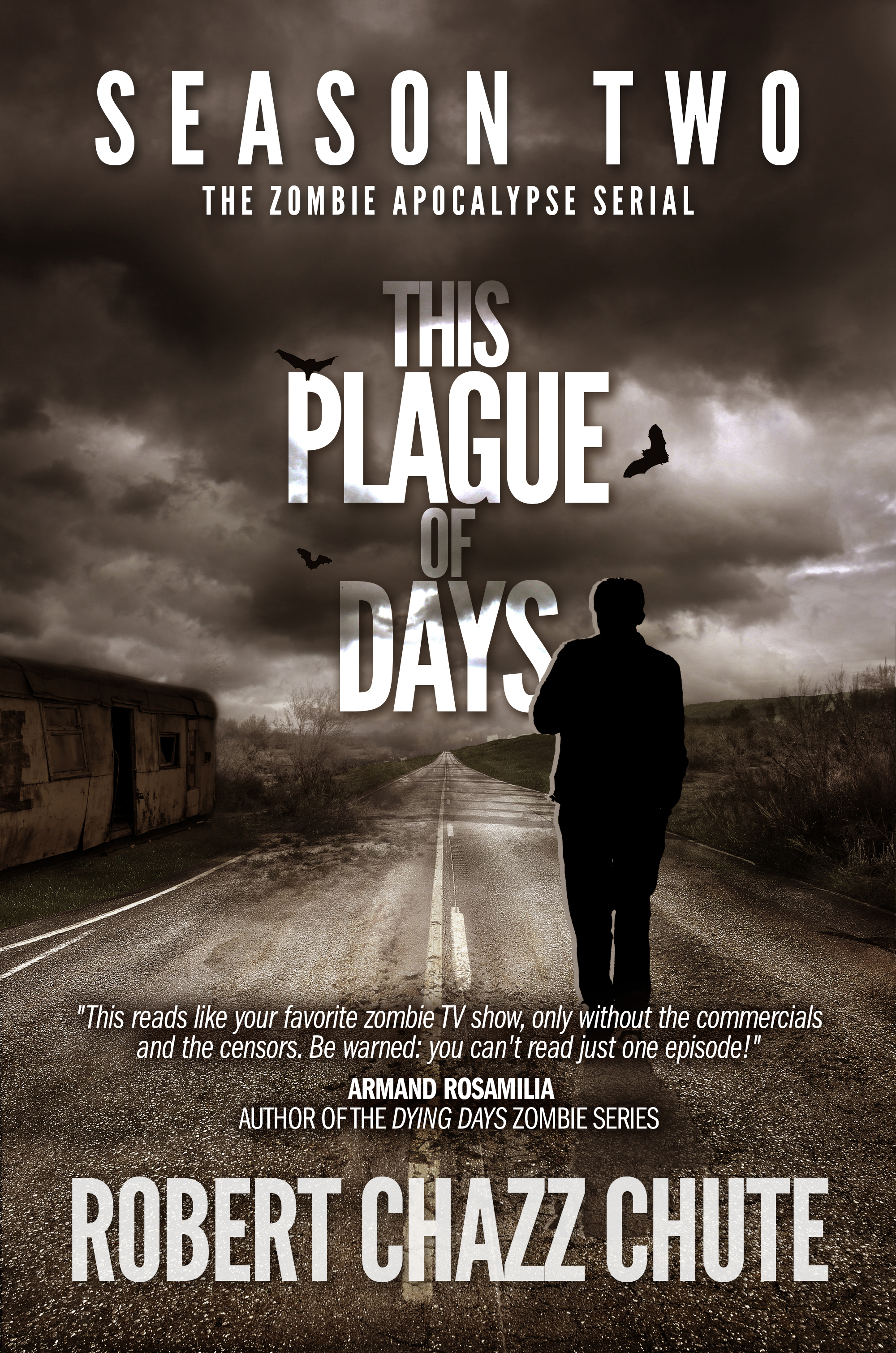
Me B&W~ Robert Chazz Chute is the author of This Plague of Days. His friends call him Mr. Sunshine.


This Plague of Days: Today’s taste

This Plague of Days 0328From today’s revisions:

She had been wrong to trust Chester, but the man with the long knife and the stolen Mercedes had taught her a few things:

First, there was fuel everywhere. Second, she was lucky to have a length of old garden hose in her hand to siphon gas. Third, she’d overestimated her ability to judge people. Fourth, life and death situations make English majors with unfinished masters theses in Elizabethan poetry feel awfully stupid.


This Plague of Days: The Serial. The Novel. (The Movie?)

English: This plague patient is displaying a s...

English: This plague patient is displaying a swollen, ruptured inguinal lymph node, or buboe. After the incubation period of 2-6 days, symptoms of the plague appear including severe malaise, headache, shaking chills, fever, and pain and swelling, or adenopathy, in the affected regional lymph nodes, also known as buboes. (Photo credit: Wikipedia)

From a recent revision of This Plague of Days (my current work in progress):

It was only four blocks, but it seemed much farther in the dark. They moved slowly, following Jack’s flashlight beam.
A dozen pairs of eyes followed them in turn — wary but fierce — unseen and circling, closer and closer. The ragged creatures, drooling and impatient, ached with hunger.

Only meat could slake them now.

~ I wrote This Plague of Days a couple of years ago. I’m enjoying rediscovering it as I revise the serial for publication. I hope you’ll enjoy it, too. (Coming end of May. Prepare yourself.)


Wash Your Hands!: The most reliable preventative against spreading disease

Person washing his hands

Person washing his hands (Photo credit: Wikipedia)

I have a guest post coming next week about go-bags. I’m hoping the buddy who is a SWAT expert who consults for my crime novels will favor us with post about getting zombie-ready, too. Before we get too much deeper into this blog, though, I have to write this post. It is at once a hopeful idea and a deflating one. Here’s the key thing you need to know to prevent the spread of disease:

WASH YOUR HANDS!

Every day we touch our faces, our mouths and eyes hundreds of times. We do it after touching doorknobs and shaking hands and borrowing a pen. The vectors of disease are everywhere, waiting for us to make this mistake. It’s such an easy fix, yet lots of people fail to do it. Sometimes I think the human race is too dumb to live and we’ve just been lucky so far. Here’s why…

How to

Use hot water and soap (and not anti-bacterial lotions if you can help it.) After you wash your hands, the best preference is to shut off the tap with your elbow or, after you dry your hands with a paper towel, turn off the tap with the same paper towel. Don’t grab the bathroom door handle with the hand you just washed and then go share popcorn with your date. Use the paper towel again, a sleeve, a glove or wait for somebody else to open the door.

Why to

I don’t have OCD. I just know how much fecal matter is on handles, ATM keys and your money. The germs on money is akin to used toilet paper. If a food handler tries to serve your food with the same dirty hands they used to take your money, do not eat it and tell the manager to retrain his or her staff.

Why does this information bring me up and down at the same time?

Because it’s the same advice given to revolutionary war soldiers to help prevent the spread of disease. Washing your hands was initially a radical idea and the doctor who first proposed the practice to decrease the incidence of infant mortality in his hospital was persecuted for it (and eventually ended up in a madhouse.)

SARS

During the SARS crisis in Toronto a few years ago (in which 44 people died), hand washing was the prime directive. That’s depressing because that was the best advice they had at the time and still is. After the invention of the microscope and vaccines and amazing medical technology, the best we can do is still ordinary hygiene you should be doing anyway. And many people don’t. We’d call them selfish pigs, though that’s an insult to pigs.

What’s worse?

I waited a long time for a surgeon to show up to give me some stitches. He’d just driven in to the office from home. Before he touched me, I asked that he wash his hands. Yes, he was going to use an anti-bacterial and wear gloves etc.,…, but first I had to ask him to do the basics. He looked mildly irritated, but he complied, so fine. No infection for me.

I knew another health care practitioner who went to the bathroom but felt he was too busy and important to wash his hands before going off to see patients. I witnessed this once personally. Even after getting berated for his negligence and disrespect, I’m sure he probably gets away with it when no one else is around to call him on it. 

Mount your defences

To protect you and your family, get in the habit if you aren’t already. Wipe down germy surfaces (kitchen counters, doorknobs, cutting boards)  with hot, soapy water, vinegar and water or organic cleaning products so food-bourne bacteria doesn’t make you sick. Wash your hands for your benefit and for the health of others.

Until better medicine comes along, basic hygiene is still the first defence against the coming plague.


A tiny excerpt of This Plague of Days from today’s revisions

This Plague of Days 0328“The ’40s and ’50s had the mushroom cloud.

The ’60s had flower power and the rocket to the moon.

The ’70s had disco, the ’80s and ’90s had a stock ticker, and the 2000s had the World Trade Center attack.”

Oliver pointed with his chin toward the wreck of the fire engine on its side, forgotten amidst the mayhem.

“There’s the new symbol of our time. Of course, like the man said, you ain’t seen nothin’ yet.”

~ This Plague of Days, by Robert Chazz Chute will be released at the end of May.